2012-01-25


From a two-pint pot
A mind for ever
Voyaging through strange seas of Thought,
Voyaging through strange seas of Thought,
alone.
-William Wordsworth describing Sir Isaac Newton
 |
 Sent to his grandmother's (Margery Ayscough) to live, he lived instead in his own world. A world that revolved around invention and experiment. It was said that all he wanted to do was study. His way. His love of Descartes, Copernicus and Galileo was outside of Trinity College, Cambridge's curriculum. It is amazing to think he, on his own, discovered the laws of gravity and motion. If he'd been a sociable man, this may never have happened. If his mother had had her way, the world would have been gifted with another farmer instead of a scientific genius
Newton made strides in mechanics, mathematics, thermodynamics, astronomy, optics and acoustics that changed the world.
Principia Mathematica (1687) is thought to be the single most important book in the history of science.
His quarrel with German mathematician Gottfried Leibniz regarding calculus is renowned. Newton accused Leibniz of plagiarism*. This was no small charge. At the time, Leibniz was was a political adviser to the Duke of Hanover, was consider the first true geologist and was both a logician and a metaphysician. The Royal Society was called in to moderate. Strangely, they never called on Leibniz to give his side of the story. They eventually reported that, indeed, Leibniz was a fraud and Newton was the true inventor of the Calculus. That Newton wrote the report himself may have had something to do with the outcome.
 He was an unparalleled genius, had a bad temper, and was an introvert. Some think introverted to the point of his having autism. Towards the end of his life, his studies in alchemy and mysticism had his contemporaries think he may have been mad. Perhaps he still knew more than they, or we, do.
"I can calculate the motion of heavenly bodies, but not the madness of people."
- Isaac Newton
My reading of him began with the QI Book of the Dead. And will expand to James Gleick's book called, simply, Isaac Newton. A fascinating and complex man. And more is being discovered about him every day.
Hideous shoe named after him.
The Ten Brightest Stars
SunSirius
Canopus
Arcturus
Rigil Kentaurus, Toliman
Vega
Rigel
Procyon
Betelgeuse
Achernar
Note: The apparent brightness of a star depends on both its inherent (absolute) luminosity and its proximity to the observer.
* Leibniz had managed to came up with calculus independently. When Leibniz published his paper on calculus in 1684, he didn't feel the need to mention Newton.
Kalmakoff: A Russian in Paris
 |
| Angel of the Abyss |
 |
| Narcissus |
 |
| Astarte |
And the artist died alone and poor with a vivid body of work left behind him. Disturbing and steeped deeply in mythology, the most beautiful are self portraits (#1 and #2 here).

2012-01-24

via Days Gone By
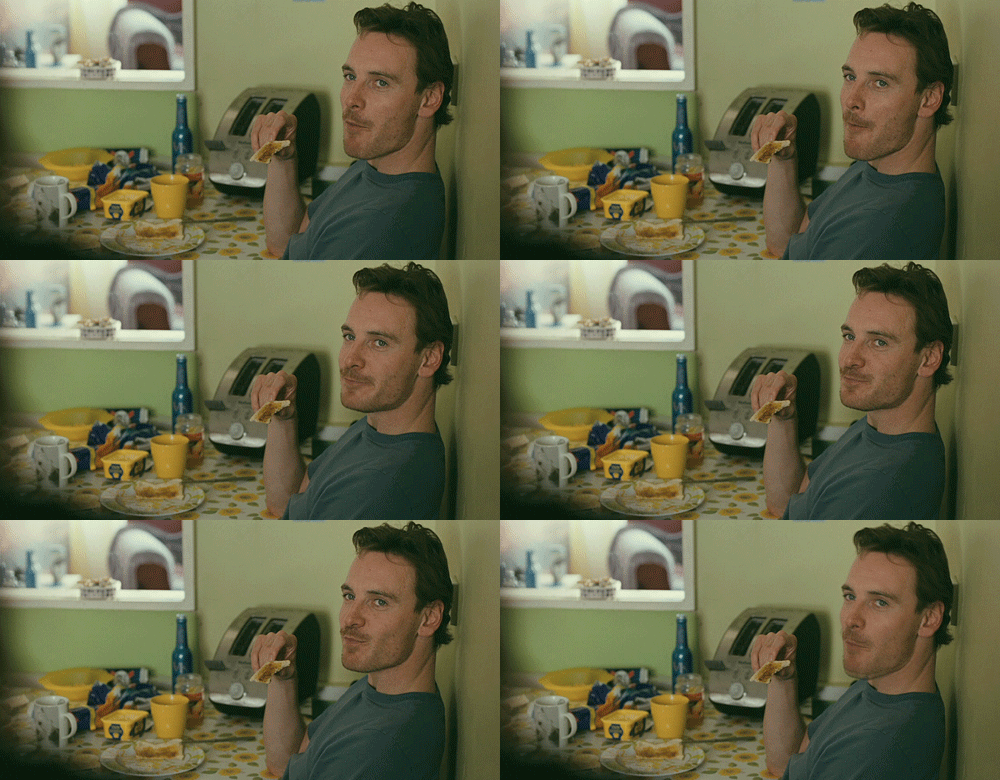
Massive Attack promo film raising awareness of Reprieve's zero dB - against music torture campaign. To support the cause visit http://zerodb.org/ or www.reprieve.org.uk
Directed by Adam And Olly and filmed in Cambridge University's anechoic chamber.
Directed by Adam And Olly and filmed in Cambridge University's anechoic chamber.


2012-01-23

- Anaïs Nin, The Diary of Anaïs Nin, Vol. 1: 1931-1934
 |
| Scott and Zelda posing for Hearst’s International Magazine, May 1923. Zelda called it her “Elizabeth Arden face” and pasted it in her scrapbook. |
Nobody knew whose party it was. It had been going on for weeks. When you felt you couldn’t survive another night, you went home and slept and when you got back, a new set of people had consecrated themselves to keeping it alive. Zelda Fitzgerald, Save Me The Waltz
F. Scott Fitzgerald’s “Dyed Siberian Horse” (And Twelve Other Descriptions of Things and Atmosphere) by Biblioklept
143. Days of this February were white and magical, the nights were starry and crystalline. The town lay under a cold glory.
144. Dyed Siberian horse.
145. As thin as a repeated dream.
146. The sea was coming up in little intimidating rushes.
147. The island floated, a boat becalmed, upon the almost perceptible curve of the world.
148. Lost in the immensity of surfaceless blue sky like air piled on air.
151. On the great swell of the Blue Danube, the summer ball rocked into motion.
152. A circus ring for ponies in country houses.
153. The tense, sunny room seemed romantic to Becky, with its odor of esoteric gases, the faint perfumes of future knowledge, the low electric sizz in the glass cells.
154. A rambling frame structure that had been a residence in the 80’s, the country poorhouse in the 1900’s, and now was a residence again.
155. The groans of moribund plumbing.
156. The silvery “Hey!” of a telephone.
161. Whining, tinkling hoochie-coochie show.
From the angels wanna wear my red shoes and Scott & Zelda Fitzgerald
2012-01-08


2012-01-07


Me, yesterday.


From Katharine Hepburn’s 1981 interview with Barbara Walters:
Hepburn: “I have not lived as a woman. I have lived as a man…I’ve just done what I damn well wanted to and I made enough money to support myself. And I ain’t afraid of being alone.”
Walters: “Is that why also you wear pants?”
Hepburn: “No, I just wore pants because they’re comfortable.”
Walters: “Do you ever wear a skirt, by the way?”
Hepburn: “I have one.”
Walters: “You have one.”
Hepburn: “I’ll wear it to your funeral.”
From Old Hollywood
2012-01-06

Subscribe to:
Posts (Atom)